
Categories
Helideck Lighting
Helideck lighting systems for offshore platforms, drilling rigs, FPSOs and vessels, covering Circle & H, perimeter lights, HAPI approach guidance, Helideck Monitoring System (HMS) repeaters and control panels, supplied by AJV Tech across the GCC and India.
Explore Our Premium Helideck Lighting Options
Discover our diverse categories of Helideck Lighting solutions tailored to meet various industrial requirements:

Helideck lighting is the set of landing-area lights, approach guidance,hazard warnings and control equipment that lets pilots and deck crews use an offshore helicopter landing area at night and in poor visibility. AJV Tech supplies helideck lighting for offshore platforms, drilling rigs, FPSOs and vessels across the UAE, Saudi Arabia, Qatar, Oman, Bahrain and Kuwait, as well as India, with equipment specified against UK CAA CAP 437 and the project’s own aviation and operator requirements.
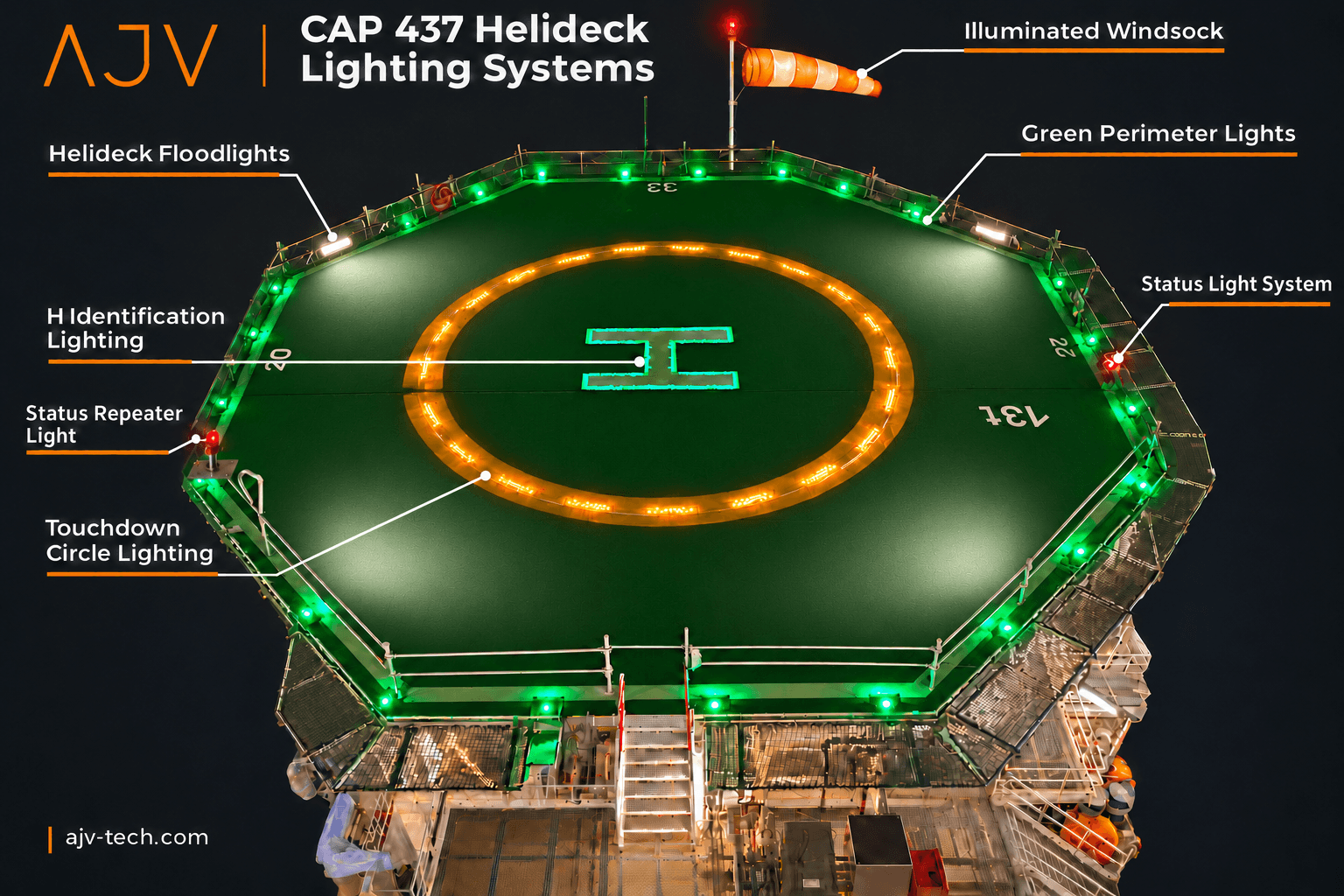
Circle & H System. The Circle & H System is the core of a helideck lighting package: steady yellow lighting traces the touchdown/positioning marking circle, and a green illuminated “H” identifies the heliport at its centre. For a retrofit, the deck material, fixing method and cable protection need to be specified. See the Circle & H System product page for the full description.
Perimeter lights. Green lights mark the boundary of the usable landing area and are supplied alongside the Circle & H System. The project needs to identify where raised fittings can be mounted and where a recessed fitting is required.
Helideck status lights. Flashing red lights warn crews of an installation hazard. Specify the fire and gas alarm interface, the manual activation point and any red repeaters needed for visibility after touchdown.
Illuminated windsocks. An internally illuminated windsock makes local wind direction visible at night. Specify mast height, mounting details and whether the obstruction plan calls for a red light at the top.
Aeronautical obstruction lights. Red obstruction lights identify structures that present a hazard near the helideck. Mast and structure elevations are needed so mounting positions and light outputs can be reviewed against the obstacle-marking plan.
Helideck surface floodlights. White floodlights illuminate work areas for deck personnel during maintenance and access. Glare, aiming and switching should be reviewed against CAP 437 Chapter 4, including restrictions during helicopter movements.
HAPI approach guidance. A Helicopter Approach Path Indicator (HAPI) gives the pilot a visual reference for the intended approach slope. Its four light sectors tell the pilot whether the helicopter is above, on, slightly below or below the specified approach slope. A HAPI enquiry should include the preferred approach direction, specified slope, available mounting position and whether the deck is fixed or moving.
Helideck Monitoring Systems (HMS). An HMS uses motion and wind data to report operational status on a moving helideck, including pitch, roll, inclination and significant heave rate. CAP 437 Appendix J specifies blue, amber and red HMS repeater lights for moving helidecks, repeating the status shown on the HMS display so flight and deck crews receive the same indication. For an FPSO, drillship or semi-submersible, specify existing sensors, data interfaces, display locations and repeater positions.
Central lighting control panel. The control panel switches the helideck lighting circuits and reports faults to the control room. Specify the circuits to be switched, the faults to be reported, where the helideck landing officer will operate the system and which circuits need backup power.
Retrofit and hazardous area selection. AJV can review a retrofit of a steel or aluminium helideck from a marked-up deck drawing showing tie-down points, drainage paths, cable entries and existing fixings, including phased upgrades with a limited shutdown window. Where equipment is mounted in a classified area, provide the zone, gas group, temperature class, ambient range, corrosion and ingress protection needs and the required ATEX or IECEx documentation; suitability is reviewed for each component at its intended mounting location.
CAP 437 sets out UK Civil Aviation Authority assessment criteria for offshore helicopter landing areas. Acceptance of a complete helideck depends on equipment selection, layout, installation and verification, so the project should state the CAP 437 edition, the applicable national aviation requirements and the operator’s acceptance criteria. AJV can coordinate helideck lighting, marine cables and electrical accessories in one project enquiry. To start, send your deck drawing, declared D-value, platform or vessel name, project location, electrical supply, equipment schedule and required delivery date to sales@ajv-tech.com or call +971 4 418
6032.
Does every offshore helideck require HAPI?
HAPI selection depends on the approach design and applicable aviation requirements. Specify the preferred approach direction and slope so the project team can assess suitability for the installation.
How do HMS repeater lights differ from helideck status lights?
HMS repeaters display moving-deck operational status using blue, amber and red indications. Flashing red helideck status lights warn of hazardous conditions on the installation, such as a gas release.
Can AJV support a helideck lighting retrofit?
Yes. Share deck photographs, existing equipment models, mounting details, power supply and cable routes, and mark the equipment you plan to retain so AJV can assess compatibility and prepare the replacement scope.
Can AJV quote hazardous area helideck equipment?
Yes. Provide the zone, gas group, temperature class, ambient range and required ATEX or IECEx documentation. Suitability is reviewed for each component at its intended mounting location.
Where does AJV support offshore helideck projects?
AJV’s UAE team supports projects in the UAE, Saudi Arabia, Qatar, Oman, Kuwait, Bahrain and India.

AJV Technical Equipment delivers customized lighting solutions and support using only reputed, certified products.
LinkedInSolutions
Explosion Proof LightingPortable & TemporaryVentilation (Ex)Industrial LightingConfined Space LightingOffshore Drilling LightingDubai: AJV Technical Equipment FZCO, A2 building, Dubai Digital Park, Dubai Silicon Oasis, PO Box: 944708, UAE
Abu Dhabi: AJV Energy Solutions LLC SPC, Office 421, Trust well Properties Building, Freej Al Qbeesat St, Al Danah, UAE

Copyright © AJV Technical Equipment 2026