
Hazardous Area Lighting Design: Process, Standards & Best Practices
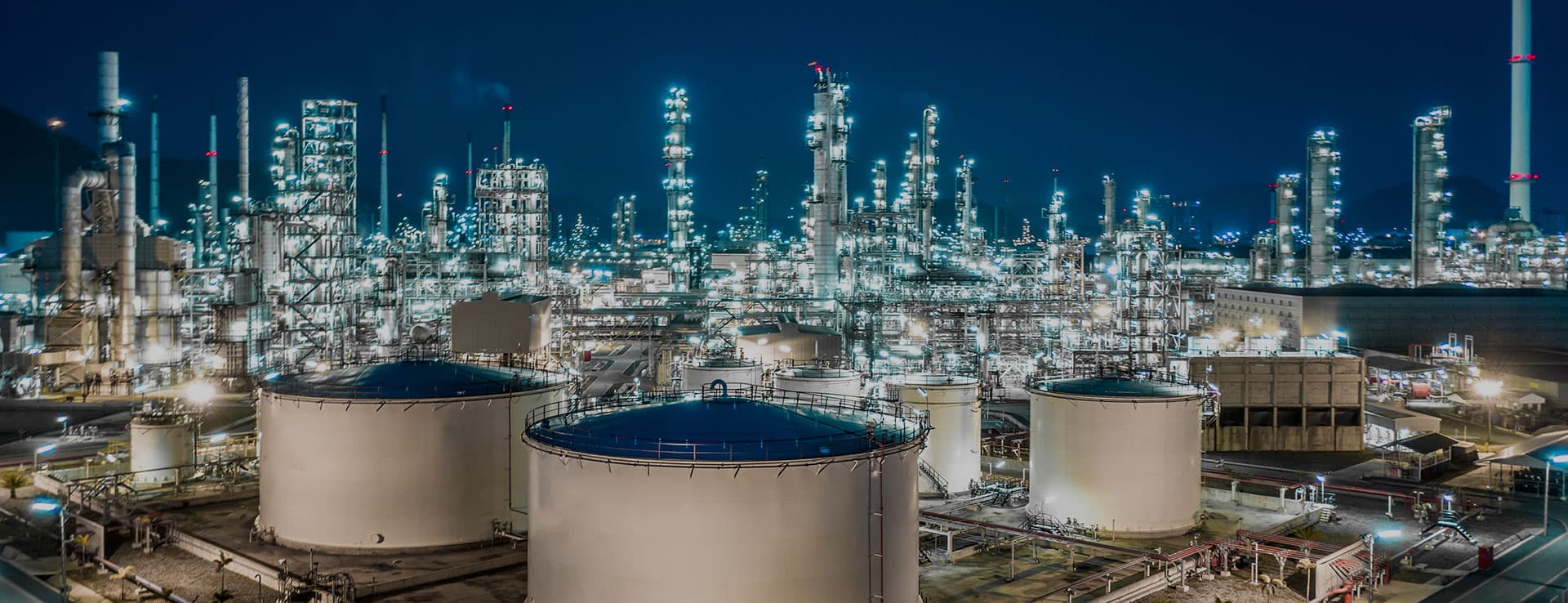
Designing lighting for hazardous areas is a specialist discipline that combines electrical engineering, photometric science, and regulatory compliance. Unlike standard industrial lighting, every fixture specified for a Zone 1, Zone 2, or equivalent classified location must be rigorously selected against the explosion protection requirements of that zone — and the overall scheme must deliver defined lux levels across the work surfaces and access routes within the hazardous boundary.
This guide explains the end-to-end design process: from reading the area classification document through photometric modelling, luminaire selection, and submission of a compliance-ready lighting schedule.
Why Hazardous Area Lighting Requires a Dedicated Design Process
Standard industrial lighting design is governed primarily by illuminance targets and energy efficiency. Hazardous area lighting design adds a third constraint: every luminaire must carry the correct explosion protection certification for its installation zone, and the scheme as a whole must be documented to show that certified products are correctly applied.
Getting this wrong carries serious consequences. An uncertified or under-specified fixture in a Zone 1 location is a potential ignition source. Insufficient lux levels on a drilling floor or in a confined space entry area create the conditions for accidents. Regulatory bodies — and operators including ADNOC, Saudi Aramco, and major EPC contractors — require lighting schedules with supporting certification evidence before they will approve material for installation.
A structured design process eliminates both failure modes: it selects the right product for the zone and produces the documentation trail that project approval requires.
Step 1: Area Classification Review
Every hazardous area lighting design begins with the area classification drawing — the document produced by process engineers that divides the plant or facility into hazardous zones based on the likelihood and duration of a flammable atmosphere being present.
Under the IEC 60079 / ATEX framework used across the GCC and internationally:
- Zone 0 — A flammable atmosphere is present continuously or for long periods. Lighting in Zone 0 is rare and requires Category 1 / Group I equipment with very high protection levels.
- Zone 1 — A flammable atmosphere is likely to occur in normal operation. Requires Category 2 equipment (ATEX) or equivalent IECEx-certified product.
- Zone 2 — A flammable atmosphere is not likely in normal operation but may occur in abnormal conditions. Requires Category 3 equipment as a minimum, though Zone 1-rated luminaires are frequently used for standardisation.
The gas group and temperature class of the specific hazard must also be confirmed. A luminaire approved for Group IIA (propane) is not automatically suitable for Group IIB (ethylene) or Group IIC (hydrogen) — the certification must explicitly cover the relevant gas group. The maximum surface temperature of the luminaire under fault conditions must remain below the auto-ignition temperature of the gas, expressed as a T-class (T1 through T6).
All of this information must be read from the classification drawing before a single luminaire is specified.
Step 2: Define Illuminance Targets
Once the zone boundaries are understood, the designer establishes the minimum average illuminance (lux) required at the working plane for each area. The primary international reference for outdoor and industrial lighting is EN 12464-2 (Lighting of Work Places — Outdoor Work Places) supplemented by CIE 154:2003 for maintenance factor methodology.
Typical design targets for common hazardous area task types include:
- General area / walkway: 20–50 lux average at ground level
- Active work areas (pipe racks, equipment decks): 100–200 lux
- Precision task areas (control panels, instrument stations): 300–500 lux
- Emergency evacuation routes: Minimum 1 lux on the centre line per EN 1838
Many major operators publish their own lighting standards that supplement or tighten these figures. ADNOC engineering standards and Saudi Aramco's SAES-P series both specify minimum maintained illuminance levels for process areas, control rooms, and safety-critical access routes. A design targeting operator approval must be benchmarked against these documents.
The maintenance factor (MF) applied in calculations is typically 0.8–0.85 for well-maintained LED luminaires. This accounts for the gradual reduction in lamp lumen output and the accumulation of dust on optics and housings over the maintenance interval. Raytec's Raytec SPARTAN photometric data is produced with an MF of 0.85 applied, in line with standard practice.
Step 3: Photometric Modelling
With illuminance targets set, the designer runs photometric calculations to determine how many luminaires are needed, where they should be positioned, and at what mounting height and beam angle. Modern lighting design software — DIALux Evo and Relux are the most widely used — imports manufacturer photometric data files (IES or LDT format) and models the light distribution across a defined surface.
Raytec provides IES photometric data files for the full SPARTAN LED range, covering floodlights in multiple power outputs (from 20 W to over 200 W), linear luminaires, bulkhead fittings, high-bay and crane configurations. These files enable design engineers to model specific SPARTAN products within DIALux and produce accurate illuminance calculations before any equipment is ordered.
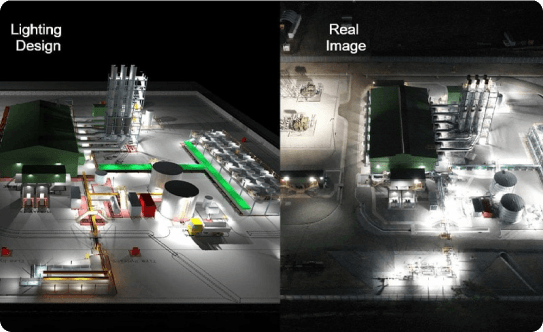
3D photometric modelling produces false-colour lux maps and luminaire schedules before any equipment is committed.
The outputs from a photometric model typically include:
- False-colour illuminance maps (2D and 3D) — a heat-map representation of lux distribution across the defined surface, immediately showing dark spots and areas of over-illumination
- Average, minimum, and maximum maintained illuminance figures for each calculation zone
- Uniformity ratio (Emin/Eave) — a measure of how evenly light is distributed; typically a minimum uniformity of 0.3–0.5 is required for safety areas
- 3D rendered views — photorealistic visualisations showing how the installed scheme will appear at night, useful for client presentations and operator reviews
- Luminaire schedule — a summary table listing each fixture type, quantity, position co-ordinates, mounting height, and wattage, which feeds directly into the material take-off
A well-executed photometric model removes guesswork from the specification process. Instead of over-specifying products to compensate for uncertainty, the model tells the designer exactly what is needed — reducing project cost and avoiding the lumen waste and glare that comes from over-lit installations.
Step 4: Luminaire Selection for the Hazardous Zone
With a photometric model confirming the required lumen output and beam characteristics, the designer selects certified luminaires that meet the zone, gas group, and T-class requirements identified in Step 1. This is where explosion protection compliance enters the product selection process.
Key selection criteria for hazardous area luminaires:
- Zone rating: Zone 1 (Ex d, Ex e, Ex nA, Ex ia, or combinations thereof) or Zone 2 minimum
- Gas group: IIA, IIB, or IIC depending on the classified atmosphere
- Temperature class (T-class): T4, T5, or T6 for most hydrocarbon applications; confirm against the specific flammable material present
- IP rating: IP66 minimum for most outdoor and offshore applications; IP67 or IP68 for submerged or washdown environments
- Ingress protection for mechanical impact (IK rating): IK08 or higher where mechanical damage risk is present
- Construction material: Marine-grade aluminium or stainless steel for offshore and coastal environments; GRP for corrosive chemical atmospheres
- Certification body: IECEx, ATEX, or both — confirm which schemes are accepted by the operator and the project's governing standard
The Raytec SPARTAN range covers Zone 1 and Zone 2 gas hazard environments across Group IIA, IIB, and IIC, with T-class ratings up to T6. SPARTAN luminaires carry both IECEx and ATEX certification, and selected products additionally hold ABS type approval for marine and offshore applications — making them suitable for ADNOC Offshore, Saudi Aramco, and other GCC operator environments where classification society acceptance is required.
The SPARTAN product family spans a wide range of form factors to cover the full spread of hazardous area lighting requirements:
- SPARTAN High-Power Floodlight — adjustable-beam area floodlighting for open decks, drilling floors, and large process areas
- SPARTAN High-Power Bay — high-bay downlighting for enclosed process buildings, compressor halls, and turbine enclosures
- SPARTAN Linear Generation II — linear format for walkways, escape routes, and confined linear spaces
- SPARTAN Bulkhead — compact wall-mounted general illumination and access point lighting
- SPARTAN Crane Luminaire — purpose-designed for overhead crane applications in hazardous areas
- SPARTAN Intelligent Emergency — emergency-rated variants with integrated self-test function and tri-colour LED status indicator; standard configuration delivers 25% light output for 3 hours, with an optional mode providing 100% output for a shorter emergency duration
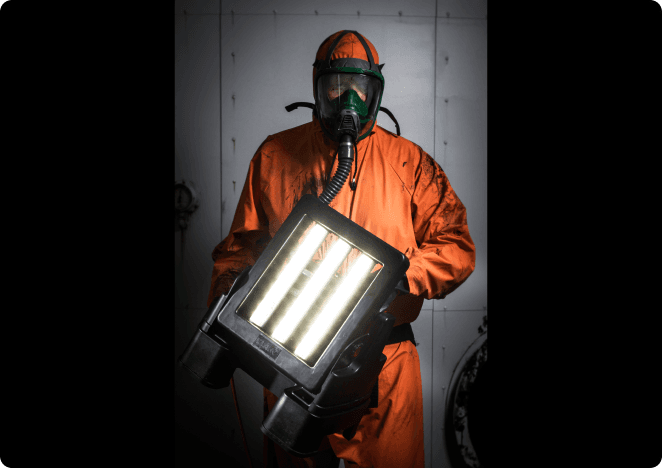
Across the range, IP ratings of IP66 and IP67 are standard — IP66 for resistance to powerful water jets, IP67 for tolerance of temporary immersion — making SPARTAN suitable for washdown environments and exposed offshore decks without additional enclosure. LED lifespan exceeds 100,000 operating hours under normal conditions, eliminating lamp replacement during the typical service life of the installation. Instant restrike capability means there is no warm-up delay when luminaires are switched on or restored after a power interruption — critical for safety on active process sites.
A further practical feature of the SPARTAN range is the removable power supply unit (PSU). In remote or difficult-to-access locations — offshore platforms, turbine nacelles, elevated deck structures — the PSU can be positioned separately from the luminaire head in an accessible location, simplifying maintenance without requiring work at height or in a confined space to service the electrical components.
AJV Tech holds stock of the core SPARTAN range and works directly with Raytec's technical team to specify the correct variant for each application, including bespoke configurations where standard products require modification for specific operator requirements.
Step 5: Luminaire Positioning and Mounting Design
The photometric model defines where luminaires need to be, but translating that into a buildable installation layout requires additional engineering. Positions must be coordinated against structural steel, pipe work, cable routes, and obstruction clearances. Mounting heights, fixture orientations, and cable entry directions all need to be confirmed before the installation schedule is finalised.
Raytec's SPARTAN products offer a wide range of mounting accessories — including pendant, surface, pole, and bracket mount options — and adjustable beam angles across the floodlight range that give the designer flexibility in achieving the required illuminance without rigid dependence on a single mounting position.
One practical advantage of directional LED floodlight technology is that strategic aiming can achieve target lux levels with fewer luminaires than a symmetrical grid layout would require. A SPARTAN floodlight mounted at a lower height but angled to cover a work area can deliver equivalent maintained illuminance to a higher-mounted symmetric fitting, at lower installed cost. Photometric modelling is the tool that makes this optimisation visible before installation.
Final luminaire positions are typically plotted on a 2D site plan extracted from the project's CAD drawings, with each fitting shown with its beam direction indicator and spread contour lines. This output becomes part of the engineering deliverable package submitted to the operator.
Marine and Offshore Environmental Design Considerations

Marine-grade SPARTAN luminaires are built for continuous salt spray, high winds, and immersion exposure on offshore structures.
Offshore and coastal installations introduce environmental stresses that must be factored into both product selection and photometric calculations. Salt film accumulates on luminaire optics and housings over time, progressively reducing effective light output if not addressed in the design. This means the maintenance factor applied in photometric calculations should reflect the expected soiling interval for the site — a more aggressive MF of 0.75 or lower may be appropriate for exposed offshore decks versus the standard 0.85 used for sheltered onshore plant.
High wind speeds, sleet, hail, and heavy rain impose structural loads on luminaire brackets and gasket assemblies. Fixing brackets must be rated for the wind loading at the installation height and orientation, and gasket integrity must be confirmed for the IP rating to remain valid under sustained water pressure from wind-driven rain. SPARTAN luminaires use marine-grade aluminium housings with stainless steel fixings throughout, which eliminates the galvanic corrosion risk that occurs when dissimilar metals contact in a salt-laden atmosphere.
UV degradation is a further consideration: materials such as GRP that perform well onshore can degrade under sustained UV exposure in tropical offshore environments. Raytec SPARTAN aluminium housings are not susceptible to UV-driven material degradation, maintaining mechanical integrity and dimensional stability over the full service life.
Step 6: Emergency and Safety Lighting Integration
Hazardous area lighting design must also address emergency lighting — illumination that maintains safe egress and work area visibility in the event of a mains power failure. In classified locations, emergency luminaires must carry the same explosion protection certification as general area fittings.
EN 1838 governs maintained emergency lighting design, specifying minimum lux levels on escape routes (1 lux on the centre line, 0.5 lux over the full route width) and open areas (0.5 lux average). For high-risk task areas where operations cannot be immediately interrupted, EN 1838 requires higher maintained illuminance — typically 10% of the normal task illuminance or 15 lux, whichever is higher.
The SPARTAN Intelligent Emergency range provides integrated battery-backed emergency lighting certified for Zone 1 and Zone 2. Each unit includes a self-testing function with a tri-colour LED indicator — removing the need for manual periodic testing and simplifying compliance with EN 62034, which mandates functional testing of emergency lighting systems at defined intervals. The standard emergency mode delivers 25% light output sustained for 3 hours; an alternative configuration can supply 100% output for a shorter emergency duration where higher illuminance during evacuation is prioritised over duration. The WARRIOR Linear series is an additional option for scenarios requiring full-output emergency illumination across extended linear escape routes in particularly harsh environments.
Emergency lighting positions are plotted alongside the general scheme and typically tested to confirm compliance with maintained lux targets before the facility is handed over.
Step 7: Documentation and Compliance Pack
A hazardous area lighting design is only as useful as its documentation. The deliverable package submitted to the operator or client typically includes:
- Photometric calculation report — DIALux or Relux output including false-colour illuminance maps and calculated average/minimum lux figures for each zone
- Luminaire schedule — fixture type, quantity, zone rating, certification reference, position, and wattage for every fitting in the scheme
- IECEx / ATEX certificates — copies of the certification documents for each product type used, confirming the zone, gas group, and T-class
- Photometric data files (IES/LDT) — used by the operator's own engineers to verify calculations independently
- 3D model or rendered views — where requested by the operator for visual review
- Wiring and cable entry schedule — confirming gland sizes, cable types, and Ex-rated cable entry arrangements for each fitting
For ADNOC and Saudi Aramco projects, the documentation package is submitted through the operator's Material Approval (MA) or Contractor Material Approval (CMA) process. AJV Tech supports this submission process by providing operator-specific submittal datasheets, pre-formatted compliance matrices, and direct liaison with Raytec's certification team where additional documentation is required.
Application in Practice: Hazardous Area Lighting on Offshore Structures
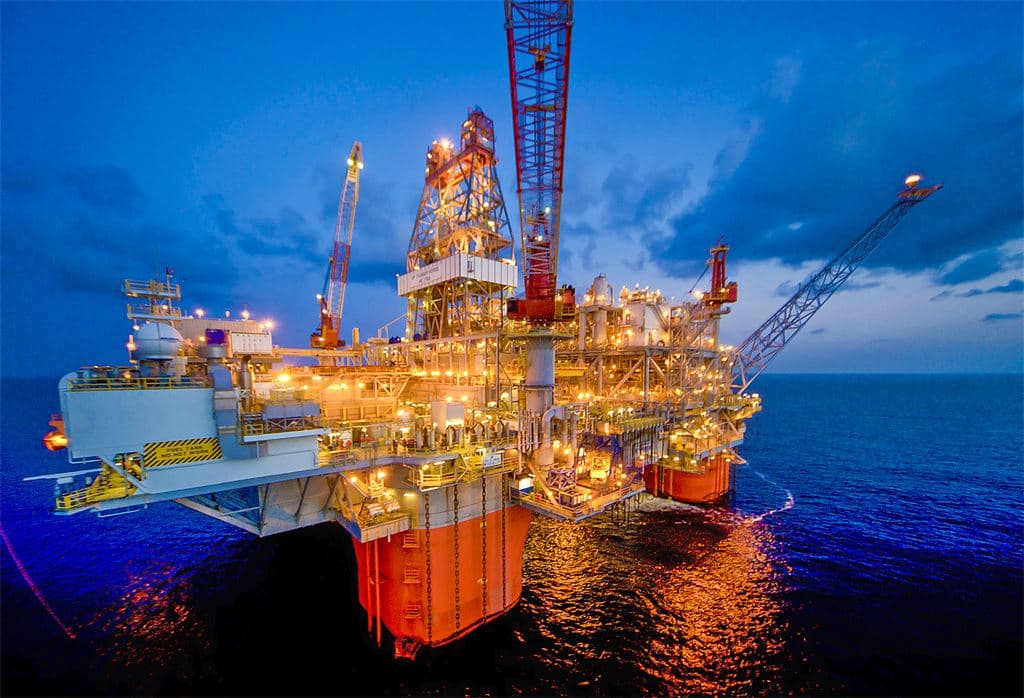
An offshore platform at night — Zone 1 and Zone 2 classified areas across the same structure demand a carefully zoned lighting design with ABS-approved products.
Offshore structures — whether oil and gas platforms, floating production units, or offshore wind turbine foundations — illustrate the full complexity of hazardous area lighting design in a single installation. The same structure typically contains multiple zone classifications, severe marine environmental exposures, remote access constraints, and a mandatory emergency lighting requirement, all of which must be addressed simultaneously.
A typical offshore structure presents three distinct lighting zones, each with different requirements:
- Jacket base / access landing: The foundation access point where crew transfer vessels make contact. This area is classified for the gas or process hazard present at the base structure, and luminaires must meet the zone and gas group for that hazard. Exposure to wave splash and salt spray is near-continuous, requiring IP67-rated marine-grade construction. Access lighting must provide sufficient illuminance for safe personnel transfer — typically 50 lux or above at the landing surface.
- Interior / enclosed mechanical spaces: Internal areas housing electrical switchgear, battery systems, or other equipment in hazardous area classifications require area lighting with the appropriate zone rating. These enclosed spaces must also have certified emergency lighting — if power is lost during maintenance operations, the engineer working inside the structure must be able to exit safely. SPARTAN Intelligent Emergency units installed in these locations provide automatic self-tested backup without requiring the maintenance team to run manual lamp tests during site visits.
- Crew access bridges and walkways: Bridge-connected access routes between structures or from access platforms to working areas carry evacuation route lighting requirements under EN 1838. Linear SPARTAN luminaires along walkway edges or overhead on structural members provide the uniform illuminance and continuity required for safe egress, with emergency-rated variants maintaining the minimum 1 lux centre-line requirement during a mains failure.
ABS marine type approval — held by selected SPARTAN products — is a requirement for many offshore structures governed by ABS, DNV, or Lloyd's Register class rules. This certification confirms that the product has been independently evaluated against marine environmental standards, and it is typically required in addition to IECEx or ATEX explosion protection certification for offshore project material approval. AJV Tech can supply SPARTAN products with the full certification stack — IECEx, ATEX, and ABS type approval — from a single source, simplifying the procurement and documentation process for offshore projects across the GCC.
Common Design Mistakes to Avoid
Even experienced engineers encounter recurring pitfalls in hazardous area lighting design. The most frequent include:
- Specifying Zone 2 product in a Zone 1 area — always verify the zone boundary extends to the proposed luminaire mounting point, not just the process equipment perimeter
- Using the wrong gas group — IIA (propane) certification is not acceptable in a hydrogen or ethylene atmosphere; confirm the gas group with the process hazard data sheet
- Ignoring T-class at elevated ambient temperatures — luminaire surface temperature rises with ambient; a T4-rated fitting may fail T-class compliance in a high-ambient process environment
- Not applying a maintenance factor — calculating to initial lux rather than maintained lux means the scheme will fall below target well before the next maintenance interval
- Overlooking obstruction shadows — photometric models must include major obstructions (pipe racks, vessels, structural columns) to give realistic lux distribution results
- Assuming certification equivalence — IECEx and ATEX are distinct certification schemes; confirm which is accepted by the operator and the national regulatory authority before finalising the product selection
How AJV Tech Supports Hazardous Area Lighting Design
AJV Tech works with engineering teams, EPC contractors, and procurement teams across the GCC and India to deliver lighting schemes that meet both the technical requirements of the hazardous environment and the approval requirements of major operators.
As an authorised distributor of Raytec SPARTAN explosion proof LED luminaires, AJV Tech provides access to Raytec's complete photometric data library — IES files, false-colour illuminance maps, 3D modelled installation views, and 3D walkthrough videos — so that engineering teams can evaluate the SPARTAN range against their specific site requirements before committing to a specification.
For projects requiring design support, AJV Tech can coordinate photometric calculations using site CAD drawings and operator-specified lux targets, producing a compliant luminaire schedule and certification pack ready for operator submission. Raytec SPARTAN products are manufactured in the UK with typical delivery lead times of two to three weeks for stocked configurations, supporting project schedules across the region.
To discuss a specific project or request photometric support for a hazardous area lighting design, contact AJV Tech directly.